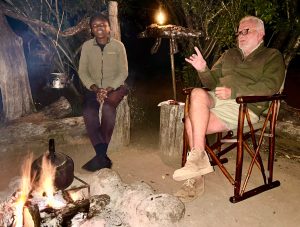

The campfire had settled into a steady, breathing glow, the old black kettle muttering softly over the coals. Flames lifted now and then beneath a sky crowded with stars. Somewhere out in the dark a hyena called, its cry thin and lonely in the night; a little later, a lion answered with a low, rolling rumble beyond the firelight, and something in all of us grew still. It was a quiet reminder that we were only guests here, sitting at the edge of a world far older, wilder and more patient than our own.
Michel, our host and guide, sat back in a worn canvas chair with an enamel mug cupped between his hands. Firelight caught the silver in his hair and deepened the lines in his face, lines earned slowly by heat, dust, wind, and years outdoors. There was a gentleness about him that made people lean in without noticing, as if his silence carried stories before he even began to speak.
At first glance, he might have looked like any elderly white South African. But it did not take long for everyone around the fire to realise there was far more to him than that. Michel had been born near what is now the Manyeleti Game Reserve. Long before fences drew hard lines across the land, and long before safari vehicles became part of the landscape, he had walked these plains barefoot with Shangaan children who knew the bush as naturally as breathing. They taught him to read the ground before he ever cared much for books, and in those early lessons he seemed to have found not only a skill, but a home.
When one of the American guests asked how he always seemed to know where to find leopards, Michel gave a small smile. “You don’t find leopards,” he said. “They decide when you have earned the privilege of seeing them.” The group laughed, thinking he was joking.
Then he turned toward the dark edge of the camp and said something softly in Shangaan. There was nothing rehearsed about it. The words came easily, with the rhythm of someone who had used the language all his life. Carol, the camp cook, looked up from the fire with a grin and answered him. A quick conversation followed, full of warmth and laughter.
“You speak Shangaan?” one of the guests asked, genuinely surprised. Michel shrugged, but there was tenderness in the gesture. “For more than fifty years,” he said. “The bush has many languages. If you only know one, you only hear part of the story.” After that, the fire seemed a little quieter, and so did we. It was as though his words had opened a door we had not known was there.
He spoke about the Shangaan trackers who had become his lifelong friends, and how they had taught him that the bush was never silent. A broken twig, a bird’s alarm call, a fresh track in the dust, each one meant something if you knew how to listen.
“The animals are always talking,” he said. “The trick is learning who they are talking about.” Then he pointed into the darkness.
“Listen.” We all did. A scops owl called once. An impala snorted. Then, from somewhere near the river, came the sharp bark of a baboon. “Leopard,” Michel said, as if he had simply read a signpost.
No radio. No GPS. Just years of paying attention. The tourists looked at one another, half amazed and half unsure what to say. Michel only smiled. “This place has been my classroom since I could walk,” he said. “I suppose I never stopped being a student.” Another log shifted in the fire and settled into red coals.
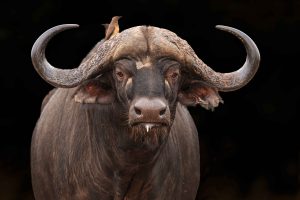
He told us about elephants that seemed to remember kindness, old buffalo bulls that vanished into the mopani only to appear exactly where they wanted to be, and lions whose characters were as different as the people sitting around the fire. What stayed with me was not only what he knew, but the way he carried that knowledge. There was no showing off, no talk of beating the bush or conquering it. Only respect, humility, and the quiet sense that belonging here meant knowing your place, and loving it enough never to take it for granted.
Later, as the night settled in properly, someone asked what had kept him in Manyeleti for so much of his life. Michel looked out past the fire, toward the dark trees and the pale sweep of the Milky Way. “You can travel the world,” he said. “I have been lucky enough to meet people from every continent, often sitting around campfires just like this. They always ask what makes Africa special.” He paused for a moment. “It is not only the Big Five, or the lodges, or even the sunsets. It is the way the bush reminds you, every morning, that you are part of something much older than yourself.”
By then the fire was low, its last red heart glowing beneath the ash. Nobody reached for a camera. Nobody checked a phone.
For a few minutes, we simply sat there and listened: to the night, to the stories, and to a man who had spent his life learning that the best safari is not about collecting sightings. It is about being changed by a place, about letting the African bush reach quietly into you and leave something there that you carry long after the dust has been washed from your shoes.
And that evening in Manyeleti, under a sky crowded with stars, it became clear that the finest guide is not simply the one who can tell you where the animals are. Sometimes it is the one who helps you understand why they are there at all, and why, for one brief and unforgettable moment, you have been invited to share the same wild and ancient world. This is Africa.
Copyright Martin Brasg
Laughing Hyena Safaris